01: Finding Your Three Adjectives
Adjective: A word that is used to give nouns more character

You have to know yourself in order to express on the outside what you are on the inside. I’m hopeful that this book will save you the decades of soul-searching it took for me to get here. A good place to start in answering the big questions— Who am I? What do I want to express? How should my exterior self reflect my interior self?—is finding your adjectives.
When I ask people to describe themselves, they often use nouns. Or they’ll choose words that are regularly used in fashion, but are rarely the same ones we use to describe our personalities or interests—our feelings, what moves us, what makes us tick.
If style tells the story of who you are, then it can’t be defined by objects or descriptions of our physicality. Who you are
is not what you like. I like potato chips, but I am not a chip. But I am a bit laid-back about what I eat—not fussy. Likewise, when it comes to fashion, you may wear a short dress, but you are not a short dress, or skinny jeans, or a V-neck top. I may have narrow shoulders, but that is hardly a way I could define myself and have you understand who I am. Yet when
I ask people to tell me about their style, they might say, “I like to wear mid-length skirts, and I hate heels.” What I’m really asking is, “What are you like as a person?” When you start to peel that back, other hackneyed style terms like “feminine,” “sexy,” and “edgy” disappear from the conversation. Those are one-dimensional terms, and most people I know are much more complicated than that.
Sometimes people are hesitant to describe themselves because they fear they’re being inauthentic, or they’re concerned they’ll be exposed as a “poser.” Can you really say that you’re interested in contemporary art if you haven’t visited a gallery in over a year? Can you truly say you love trying different foods from all over the world if you’ve eaten nearly every meal this month standing over the kitchen sink? In my book, yes. The point of style is that it’s aspirational; it tells the story of who we truly want to be, even if we aren’t able to live that way every day. Style lets us dream. I may not be able to afford
a Phillip Johnson glass house, and maybe I can’t swing that trip to India just yet, but the point is, those yearnings are in me—the curiosity to discover things I do not yet know, and the desire to push forward and experience newness, but with respect for the past.
So, regardless of what my house, my travel schedule, or my museum memberships look like, I choose to define myself based on my desires: Modern. Effortless. Classic.
Choose three adjectives. Any more than three will confine you; the more you elaborate, the more you box yourself in. And oddly enough, less than three will box you in, too; it defines you too narrowly, with no room to move. If I were to refer to myself as “chill” only, then it might convey that I run around in tiered peasant skirts and let my kids play with knives. If I use only the word “modern,” it would probably present me in a light that is a little harsh and rigid. And “classic” would never be enough on its own to tell my whole story.

01: Finding Your Three Adjectives

You have to know yourself in order to express on the outside what you are on the inside. I’m hopeful that this book will save you the decades of soul-searching it took for me to get here. A good place to start in answering the big questions— Who am I? What do I want to express? How should my exterior self reflect my interior self?—is finding your adjectives.
When I ask people to describe themselves, they often use nouns. Or they’ll choose words that are regularly used in fashion, but are rarely the same ones we use to describe our personalities or interests—our feelings, what moves us, what makes us tick.
If style tells the story of who you are, then it can’t be defined by objects or descriptions of our physicality. Who you are
is not what you like. I like potato chips, but I am not a chip. But I am a bit laid-back about what I eat—not fussy. Likewise, when it comes to fashion, you may wear a short dress, but you are not a short dress, or skinny jeans, or a V-neck top. I may have narrow shoulders, but that is hardly a way I could define myself and have you understand who I am. Yet when
I ask people to tell me about their style, they might say, “I like to wear mid-length skirts, and I hate heels.” What I’m really asking is, “What are you like as a person?” When you start to peel that back, other hackneyed style terms like “feminine,” “sexy,” and “edgy” disappear from the conversation. Those are one-dimensional terms, and most people I know are much more complicated than that.
Sometimes people are hesitant to describe themselves because they fear they’re being inauthentic, or they’re concerned they’ll be exposed as a “poser.” Can you really say that you’re interested in contemporary art if you haven’t visited a gallery in over a year? Can you truly say you love trying different foods from all over the world if you’ve eaten nearly every meal this month standing over the kitchen sink? In my book, yes. The point of style is that it’s aspirational; it tells the story of who we truly want to be, even if we aren’t able to live that way every day. Style lets us dream. I may not be able to afford
a Phillip Johnson glass house, and maybe I can’t swing that trip to India just yet, but the point is, those yearnings are in me—the curiosity to discover things I do not yet know, and the desire to push forward and experience newness, but with respect for the past.
So, regardless of what my house, my travel schedule, or my museum memberships look like, I choose to define myself based on my desires: Modern. Effortless. Classic.
Choose three adjectives. Any more than three will confine you; the more you elaborate, the more you box yourself in. And oddly enough, less than three will box you in, too; it defines you too narrowly, with no room to move. If I were to refer to myself as “chill” only, then it might convey that I run around in tiered peasant skirts and let my kids play with knives. If I use only the word “modern,” it would probably present me in a light that is a little harsh and rigid. And “classic” would never be enough on its own to tell my whole story.

I recognize that determining your adjectives is one of the hardest steps. It involves real honesty with yourself about who you are and who you want to be. But uncovering your adjectives is worth the work, because once you do it, you will find you have the answers—every time—for why something is or is not working in your closet, or for how you are communicating your style.
Right now, if you’re frustrated by the contents of your closet, I’m sure you most often blame it on a few different reasons:
• You have nothing new to wear, or it’s not on-trend enough.
• You would feel better if only the outfit made you look slimmer.
• Maybe you’re wearing the wrong color; your mom always said you looked pale in green.
What I bet you already know is that when you did go out and buy the new trend item, or the item that made your stomach look flat, or the sweater that flattered your skin tone, it did not solve your problems. If it did, we’d all be stylish in the newest dress, made of spandex, in a flattering shade of blue.
When you know your adjectives, you will become the expert problem-solver in your closet. Every time I hate what I have on, when I feel not at all like myself, it comes down to whether or not the pieces I’m wearing reflect my adjectives: chill, modern, and classic. Not just one of the adjectives on its own, but all three.
If I am frustrated in a black suit with a strong shoulder and a high pointed heel, knowing my adjectives helps me create my fix. It’s not about finding a suit with a stronger shoulder that is more “now.” It’s about being able to recognize that my entire look is modern with a hint of classic. But “chill”? It’s missing. Knowing what’s missing directs me to switch out the aggressive heel for a flat, immediately adding a more effortless vibe to the look and making it more me—my style. Unless you know your adjectives, you cannot fix your style issues.
If you start by writing out your adjectives, it’s hard. You often find yourself thinking about how others would describe you— how a past partner defined you, or what your teachers said about you. I find that one of the most revealing methods for uncovering what you are really about is writing out some of your favorite quotes. I’m not talking about “Take one item off before you leave the house” type quotes. I mean any quotes that really mean something to you. When you hear a quote and have an “ah-ha” moment, that often means it really resonates with what you know to be true. When you internalize a quote, hold onto it, and use it frequently, it speaks to your character, your fundamental traits.
THE CREATIVE PRAGMATIST
We’ve established that my personal style is modern, effortless, and a bit classic. But I wanted to create a language that would get to the heart of the matter—that would help identify the threads that connect people who share this sensibility. So, I coined the term “Creative Pragmatist” as a way to bypass all the rules, formulas, and diktats that have been ingrained in us by a range of sources, from that overly judgmental person in your high school to the exaggerated headlines you find in fashion magazines. Those rules and formulas are subconsciously reinforced every time we enter a department store and see neatly carved-out areas—first by price point, then by one-dimensional style clichés: bohemian, girly, edgy, sexy, modern, or classic.
We’ve essentially been served these same six style choices over the decades. At first glance, that sounds like a lot. But what if you pull a bit from a few of those groups? What if you are laid-back, as “bohemian” would imply, but the fringe and peasant skirts just don’t resonate? What if you appreciate the colors in the “feminine” area, but not the prints—or you’re into the strong lines of the “edgy” items, but turned off by the spikes and rips? Maybe the plunging neckline of the “sexy” dress looks good to you, but the fabric is too tight, and the zippers look cheesy. Meanwhile, the “modern” or “minimalist” section is intriguing, but how the hell are you supposed to go about your life in these pure-looking clothes? And while you crave the rich, luxurious fabrics in the “classic” section, the proportions can feel average and overly familiar.
Of course, no store or designer really intends for you to box yourself into one look like this. But the way so many stores are merchandised simply doesn’t allow for fluidity or mixing. As a designer, I can attest that there is a tremendous amount of pressure from buyers and merchandisers to “choose a lane.” Stay in your lane, lest you confuse the store or the customer. Wavering is perceived as a lack of focus. It was this set of “rules” that left me feeling cornered—choosing Team Boho or Team Modern, when I knew I was never really one or the other.
So, I created my own term. It’s still succinct, but it allows me to move comfortably between different aesthetics and cravings with the knowledge of my common through lines. I refer to myself as a Creative Pragmatist: I appreciate creativity and beautiful design, but I can’t compromise on function, comfort, or ease; I need clothes I can actually wear in real life. Let’s be honest: getting dressed should be the easiest thing we do every day. We have families, careers, friends, and interests to get to, and what we wear shouldn’t be distracting us from any of that. In fact, it should be helping us be better parents, workers, friends, and people.
THE CREATIVE PRAGMATIST SLIDING SCALE
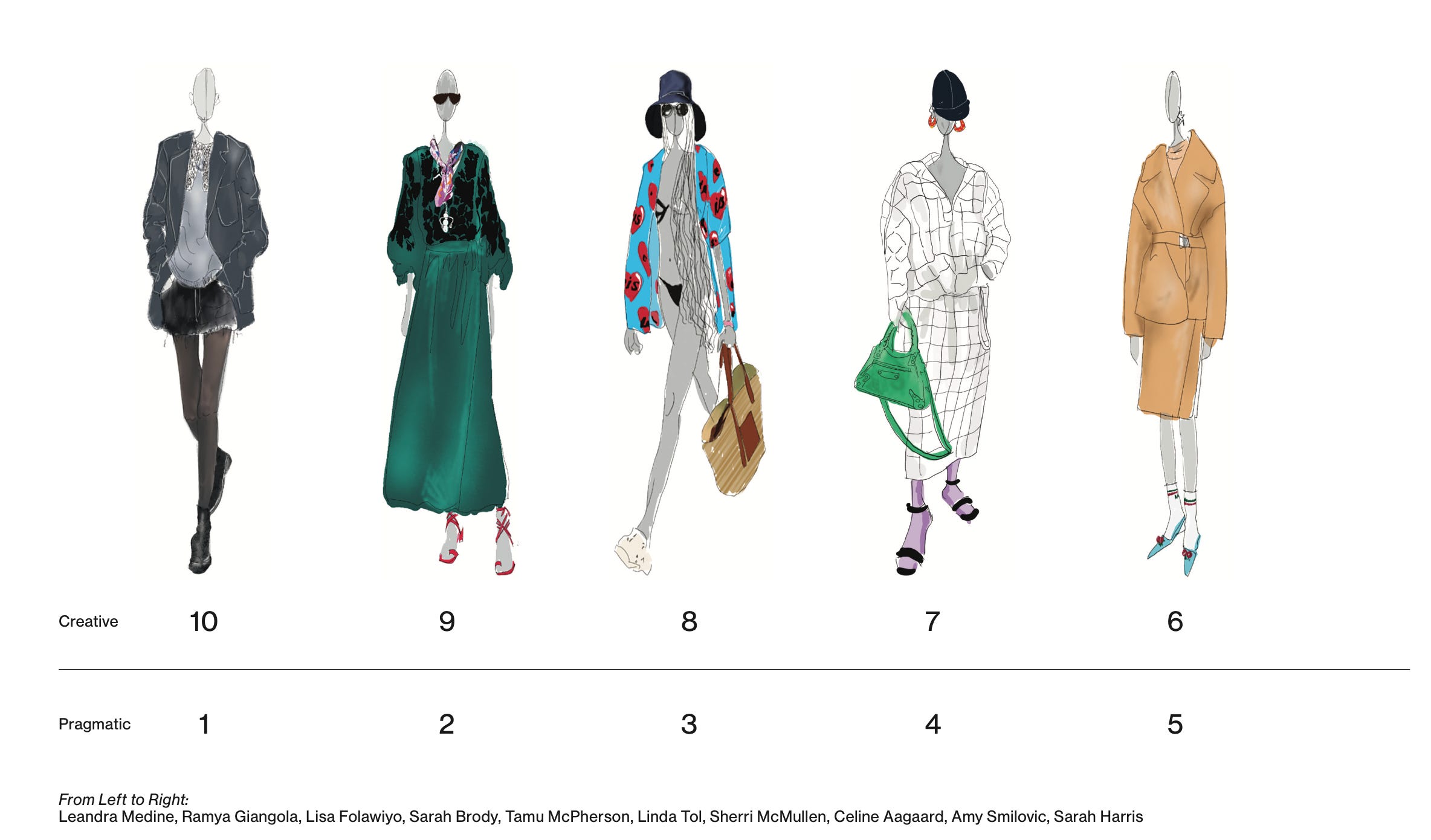
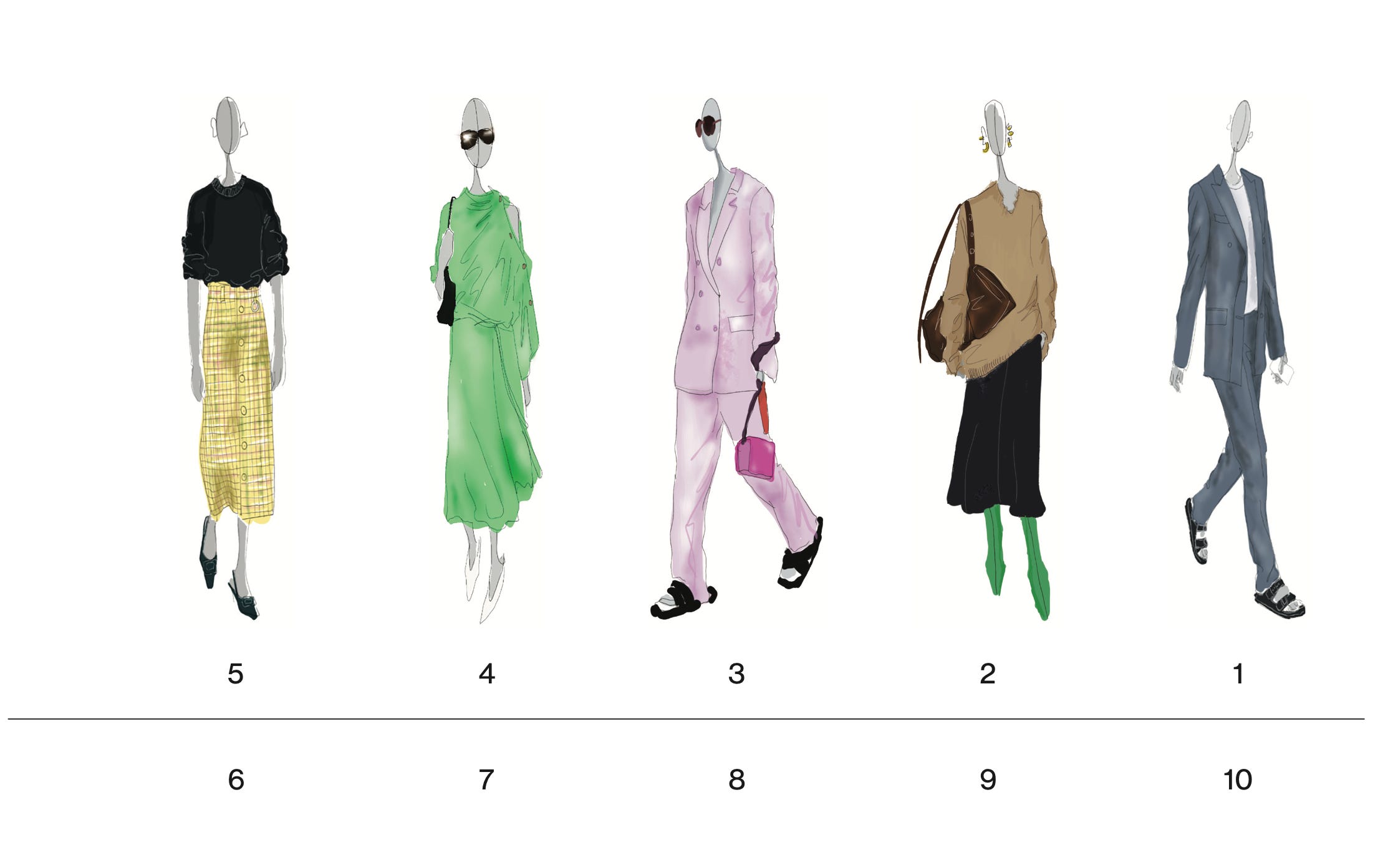
The beauty of being a Creative Pragmatist is that it’s a sliding scale. You travel along a line rather that move around
within a box. One can move along the scale depending on your mood, veering from highly creative looks—but every piece ultimately still has utility—to highly pragmatic ones, which still maintain a decided sense of modernity and interest. One day, you might be a C3-P8, and the next, a C9-P2. No matter where you are on the Creative Pragmatist scale, the through line is there: effortless, modern, and always a bit classic.
Do an image search for any of the women listed below. You’ll find a huge range of outfits, each dependent on where
they were at the time, what they were doing, and what was happening that year or that decade. Maybe their hair or their accessories reflected their mood that day. But nowhere do you see a uniform on step-and-repeat. Rarely do you see a hairstyle that has never changed or evolved, because everyone here is living in the present. They are highly curious about their surroundings. They are creatives, but not necessarily in the literal sense. I simply mean that they have an open mind in life, a thoughtful approach, and like all of us, they’re still evolving. And that is key: they haven’t fully arrived in dress, thought, or behavior. To have arrived implies you have stopped, that you are done learning and growing—and a Creative Pragmatist never stops. It is that very thing that gives them permission to experiment, to fail, and to grow, and their choice of clothing reflects this.